Hacerse a un lugar
Se calcula que más del 40% de los asentamientos humanos en América Latina son producidos de manera espontánea. Esto quiere decir que nuestros territorios son, en muchos casos, habitados en un ámbito “ilegal”, pues no resultan de la planificación formal de las ciudades y son mal llamados tugurios, favelas, villas, comunas.
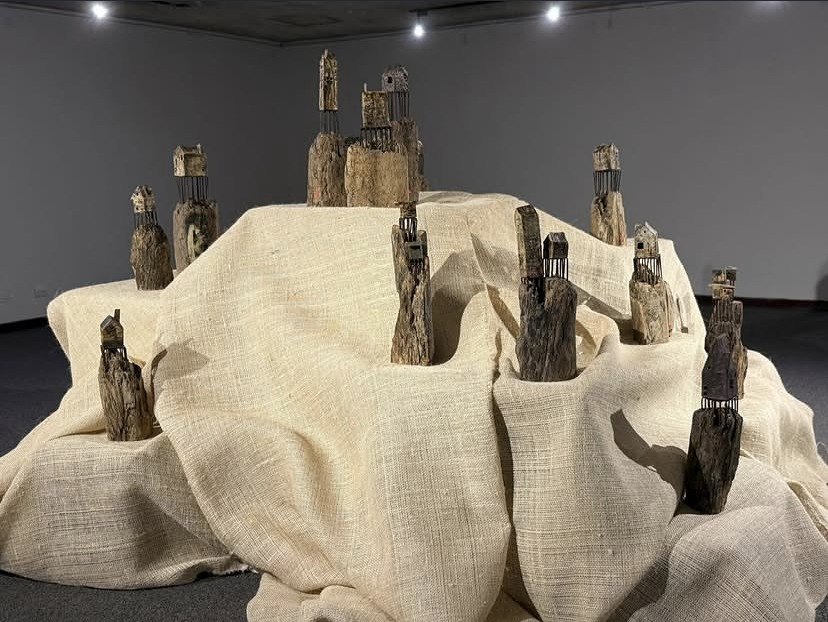
Esta serie es inspirada en uno de tantos barrios que aparecen en nuestras ciudades colombianas bajo esta lógica, poblaciones que parecen brotar de la tierra en topografías escarpadas de difícil acceso, y se funden miméticamente con el paisaje mismo a manera de palafitos, entretejiéndose y diluyéndose en la geografía donde aparecen; con una estética mágica que nos hace recordar las ciudades imaginarias de Italo Calvino.
Estas maneras de “hacerse a un lugar”, distantes de las lógicas normativas, se construyen a partir de lo disponible, fundando estéticas desgastadas, desdeñadas, precarias, impulidas, porosas, bizarras —carentes de la homogeneidad y del brillo—, como bien lo dirían Borriaud y Byung Chul Han. Las elaboraciones simbólicas se dan a partir de la casa como punto de partida y de los objetos cotidianos que acompañan esas maneras de habitar. Habitares que en su materialidad se escriben con marcas y caligrafías a manera de palimpsestos y se traslapan de manera discontinua tejiendo historias.
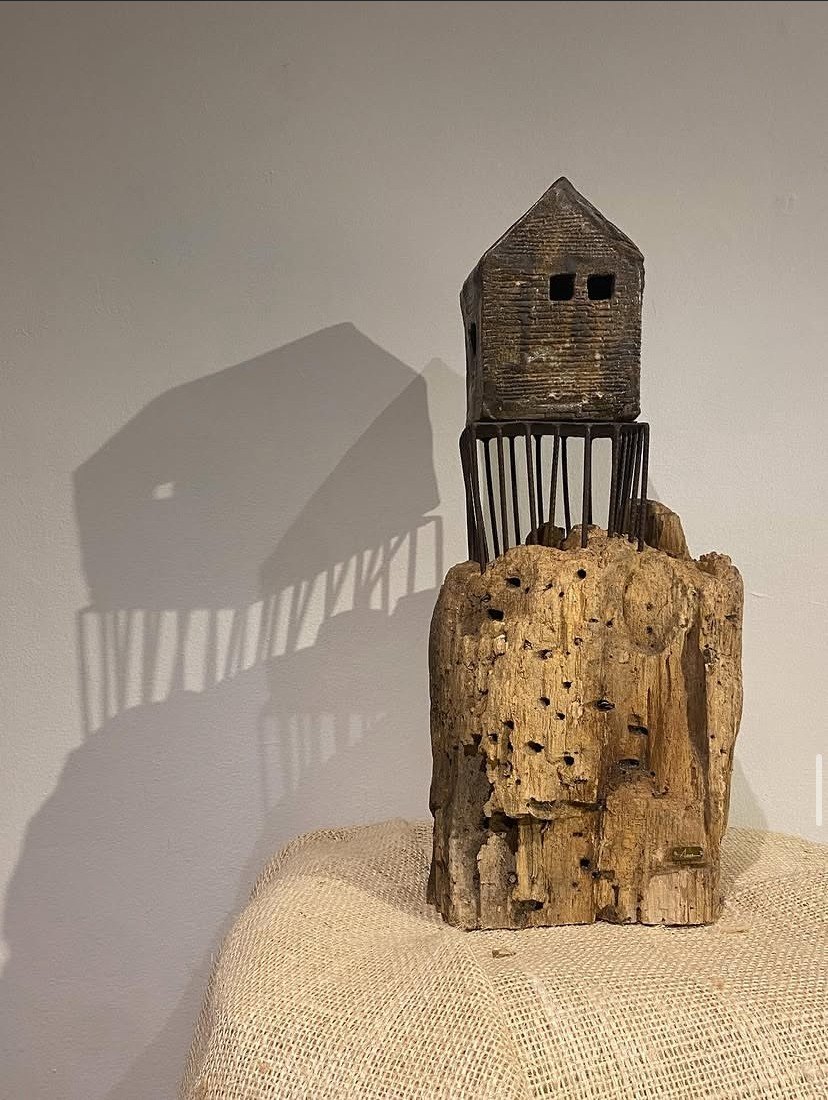
La materialidad de la obra en tanto la cerámica, obedece a una reflexión sobre la tierra como esencia y al fuego como calor; con efectos e improvisaciones resultantes de la maleabilidad misma de la arcilla; donde su apelmazamiento y su cocción, tienen que ver con lo emotivo de estos habitares propios como fragmentos de mundo. El hierro simboliza la manera en cómo esas moradas se aferran a la tierra, evidenciando el elemento de mayor rigidez del palafito, que a pesar de su aparente fragilidad, tiene pretensiones de hacerlas únicas. La madera, está tallada y labrada por la fuerza del agua que la golpea reiteradamente, como un golpeteo que araña, cicatriza, que hace marca, que deja huella. La combinación de todos estos materiales responde a un recurso estético y simbólico donde cada uno de ellos tiene un sentido y es protagonista del objeto mismo. El color de los materiales responde a una pretensión plástica de elevar la sal de la tierra y anímica de pasar desapercibido, en tanto responde a estos habitares que parecieran inexistentes en otros mundos.
por Andrea Marulanda
It is estimated that more than 40% of human settlements in Latin America are produced spontaneously. This means that our territories are, in many cases, inhabited in an “illegal” environment, since they do not result from the formal planning of cities and are incorrectly called slums, favelas, villas, communes.
This series is inspired by one of the many neighborhoods that appear in our Colombian cities under this logic, populations that seem to sprout from the earth in steep topographies that are difficult to access, and merge mimetically with the landscape itself in the form of stilt houses, interweaving and diluting themselves in the geography where they appear; with a magical aesthetic that makes us remember the imaginary cities of Italo Calvino.
These ways of “making oneself to a place”, distant from the normative logics are built from what is available, founding worn-out, disdained, precarious, impulsive, porous, bizarre aesthetics —lacking homogeneity and brilliance—, as Borriaud and Byung Chul Han would say. The symbolic elaborations occur from the house as a starting point and the everyday objects that accompany these ways of living. Habitats that in their materiality are written with marks and calligraphy like palimpsests and overlap discontinuously, weaving stories.
The materiality of the work as ceramics is due to a reflection on the earth as essence and fire as heat; with effects and improvisations resulting from the very malleability of clay; where its caking and cooking have to do with the emotional nature of these own habitats as fragments of the world. The iron symbolizes the way in which these dwellings cling to the earth, evidencing the element of greater rigidity of the stilt house, which despite its apparent fragility, aims to make them unique. The wood is carved and carved by the force of the water that hits it repeatedly, like a knock that scratches, heals, that makes a mark, that leaves a mark. The combination of all these materials responds to an aesthetic and symbolic resource where each of them has a meaning and is the protagonist of the object itself. The color of the materials responds to a plastic attempt to elevate the salt of the earth and an emotional desire to go unnoticed, while it responds to these habitats that seem non-existent in other worlds.
by Andrea Marulanda
Andrea Marulanda Montes
Manizales, 1973. Arquitecta de la Universidad Nacional de Colombia, especialista en Diseño Interior de Central Saint Martins en Londres, magíster en Filosofía de la Universidad de Caldas y doctora en Artes de la Universidad de Antioquia, con distinción Magna Cum Laude. Es profesora asociada de la Universidad Nacional de Colombia, sede Manizales.
Su trabajo —como investigadora, como docente y como artista— gira alrededor de una sola pregunta: cómo habitan los seres humanos el mundo. La ha perseguido en el barrio autoconstruido, en el muralismo urbano, en el arte callejero como bien común, y en el libro Pensar el habitar: una aproximación filosófica a la arquitectura (2022). Ha sido ponente en trece congresos y seminarios en Colombia, Argentina y Chile.
Su obra se ha expuesto en el Museo de Arte de Caldas, el Centro Cultural Rogelio Salmona, la Feria del Millón y galerías de Bogotá, Pereira y Nueva York. Más de setenta piezas de la serie Hacerse a un lugar están hoy en colecciones privadas.
Manizales, 1973. Architect from the Universidad Nacional de Colombia, specialist in Interior Design from Central Saint Martins in London, Master in Philosophy from the Universidad de Caldas and PhD in Arts from the Universidad de Antioquia, with Magna Cum Laude distinction. She is an associate professor at the Universidad Nacional de Colombia, Manizales campus.
Her work —as a researcher, a teacher and an artist— turns on a single question: how human beings inhabit the world. She has pursued it in the self-built neighbourhood, in urban muralism, in street art as a common good, and in her book Pensar el habitar: una aproximación filosófica a la arquitectura (2022). She has spoken at thirteen conferences and seminars in Colombia, Argentina and Chile.
Her work has been exhibited at the Museo de Arte de Caldas, the Centro Cultural Rogelio Salmona, Feria del Millón and galleries in Bogotá, Pereira and New York. More than seventy pieces from the series Hacerse a un lugar are now held in private collections.